


Overview
Enterprise AI has moved from pilot to platform faster than most IT organizations planned for. Claude, Copilot, ChatGPT and Gemini now sit on thousands of desktops, and engineering teams are building MCP servers and agents on top of them. What hasn’t kept pace is the operating model behind it all.
That’s where our Managed Intelligent AI Operations pod closes that gap. A dedicated team runs, governs and supports your AI stack across every vendor, and gives your builders hands-on engineering help, so IT, Security and Engineering can stay focused on their own priorities.
The problem: AI adoption is outpacing operational control
Most enterprises didn’t choose a single AI platform. They ended up with several, adopted team by team, each with its own console, billing model and access controls. The outcome is an AI estate that grows faster than anyone can govern it.
Resulting in 4 core problems:
Multi vendor sprawl
Most enterprises didn’t plan a multi-vendor AI strategy. They got one anyway: marketing adopted ChatGPT, engineering standardized on Claude, Microsoft 365 brought Copilot, and the data team builds on Azure OpenAI or AWS Bedrock. Each choice made sense on its own. Together, they leave you with an AI estate nobody can see in full.
Cost and access risk
AI spend is easy to start and hard to see. Seats are bought by department, API usage is billed by the token, and costs are spread across invoices, cloud bills and expense reports. Access tends to be just as scattered.
Builders without backup
The real value of AI comes when it connects to your own systems and data. That’s why engineering teams are building MCP servers, wiring AI into internal tools, and putting agents into production. But most are doing it without a playbook.
Engineering drain
When nobody owns AI operations, the work doesn’t go away. It gets absorbed by the people who can least afford the distraction.
The solution: Managed AI Operations Pod
1 core pillar of CloudEQS’s Intelligent Operations Managed Service is the AI Operations pod. Our Managed Enterprise AI Operations model closes that gap by giving the work to a single team that owns your AI estate end to end.
Who is in the CloudEQS pod?
Each CloudEQS pod brings together three specialist roles, so governance, platform operations and builder support all sit with one dedicated team.
| Role | What they own |
| AI Operations Lead | Governance, SLA and FinOps reporting, vendor management; your single point of accountability |
| AI Platform Engineers | Consoles, identity, API keys, workspaces and FinOps tooling; more automation as scope grows |
| AI Solutions Engineers | Hands-on support for users and builders on MCP servers, agents, Claude Code and APIs |
What does the CloudEQS pod cover?
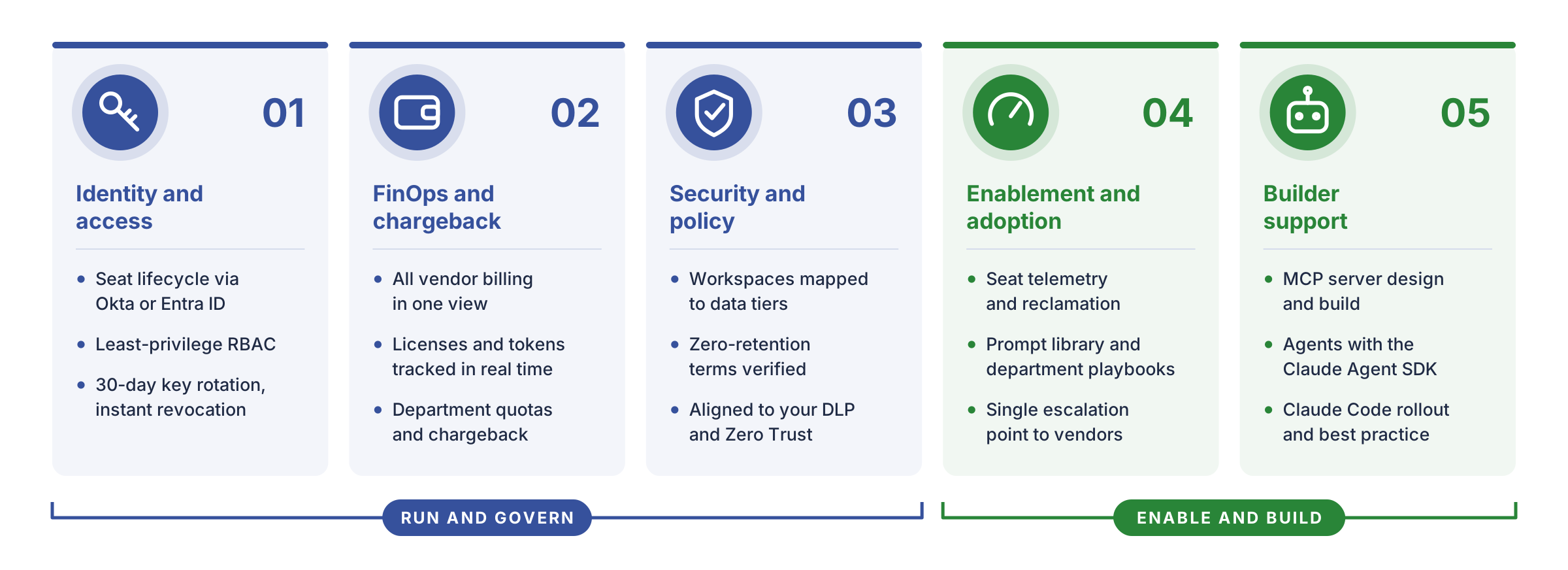
The pod’s scope covers five areas, from running and governing your AI platforms day to day to helping your teams build on them.
How the pod supports you
Support is organized into three tiers. Responsibility moves to CloudEQS in stages, so you never hand over more than the team has proven it can carry.
| Support Tier | Owner | Typical work |
| L1 | Your IT service desk | User intake and triage, password and how-to requests, routing to L2 through your ITSM |
| L2 | CloudEQS pod, from go-live | SSO, SCIM, RBAC and license issues; workspace, API key and quota changes; builder troubleshooting and code-level debugging; vendor tickets managed to closure |
| L3 | CloudEQS pod, phased in | Root-cause analysis and problem management, automation and policy-as-code, co-building MCP servers and agents, architecture and production-readiness reviews |
Summary
CloudEQS Managed Enterprise AI Operations provides a dedicated team to manage, govern, and optimize your enterprise AI ecosystem. From multi-platform administration and AI cost management to agent support, MCP server operations, and production readiness, we help enterprises scale AI securely and efficiently with one accountable team.

Comments are closed