


Overview
Enterprise data strategy has moved in waves, each one solving the last generation’s problem while quietly creating the next. First was the move to the cloud, as organizations lifted workloads out of on-premises data centers for scale and flexibility. Then came the move to the modern data warehouse and data lake, consolidating the reporting and analytics that cloud migration alone hadn’t fixed.
Both moves solved real problems. Neither solved the underlying one: data kept accumulating in more places, under more definitions, faster than any warehouse could reconcile. The result is a landscape where the same metric can carry five different definitions depending on which dashboard, department, or database it came from.
That was survivable when humans were the only ones querying the data. It isn’t now that AI agents are. Agents expect to ask a question and get a trustworthy answer, with no human standing by to catch a wrong assumption — and a warehouse that centralizes data isn’t the same as a layer that makes that data understandable to a system interpreting it on its own.
This is the problem the Enterprise Intelligence Platform (EIP) is built to solve, and it’s quickly becoming the architecture CIOs, CDOs, and data leaders are converging on as they prepare their organizations for an AI-driven future.
Why the Industry Is Moving This Way?
This shift isn’t theoretical — it’s showing up in how data leaders are prioritizing their roadmaps, and in some sobering numbers about where most organizations actually stand.
Enterprises have a data readiness problem long before they have an AI problem. Only 7% of enterprises describe their data as completely ready for AI, according to a 2026 Cloudera and Harvard Business Review Analytic Services study, and separate research from Fivetran’s 2026 Agentic AI Readiness Index found only 15% of data leaders consider their organization fully ready to deploy AI agents in production. Underneath both numbers is the same root cause: nearly 80% of data teams report spending more than half their time on data preparation rather than generating insight, because the data itself is scattered across warehouses, applications, knowledge bases, and legacy BI tools with no consistent definitions tying them together.
That fragmentation, tolerable when a human analyst could apply judgment to reconcile conflicting numbers, becomes a liability the moment an AI agent is the one answering the question. Agents don’t know to double-check whether “revenue” means the same thing in the CRM as it does in the data warehouse — they’ll simply return an answer, confidently, from whichever definition they happen to find. Industry analysts have gone as far as predicting that 60% of agentic analytics projects relying solely on point-to-point data access, without a consistent semantic layer underneath, will fail by 2028 for exactly this reason.
This is why governance and portability have jumped to the top of the data leadership agenda: recent surveys show scalability across data sources (92%), consistent metric portability (83%), and AI governance and observability (82%) as the leading three-to-five-year priorities for data organizations. Enterprises that have made the shift are seeing the payoff — benchmarks show that pairing a governed semantic layer with a proper context layer for AI can produce roughly 3x the query accuracy, at 95%+ reliability, compared to ungoverned approaches.
The Enterprise Intelligence Platform is the architectural response to all of this: a way to make data trustworthy and consistent for both existing BI workflows and the AI agents that are rapidly becoming the new front door to enterprise analytics.
What Is The Enterprise Intelligence Platform?
At its core, an Enterprise Intelligence Platform is an architecture that turns fragmented, siloed enterprise data into a single, governed, AI-ready source of intelligence. Rather than connecting every consumer — every dashboard, every analyst, every AI agent — directly to raw data sources, an EIP inserts one governed layer between the two: a place where every metric, entity, and business rule is defined once, consistently, and made available to everything downstream.
The result isn’t just cleaner reporting. It’s a foundation that both people and machines can trust and query in the same way, getting the same answer, every time.
The Architecture, Layer by Layer
The EIP architecture is deliberately simple to describe, even though what it replaces is not: data sources feed into one centralized semantic layer, and every consumer — human or machine — draws from that same layer rather than from the raw sources directly.
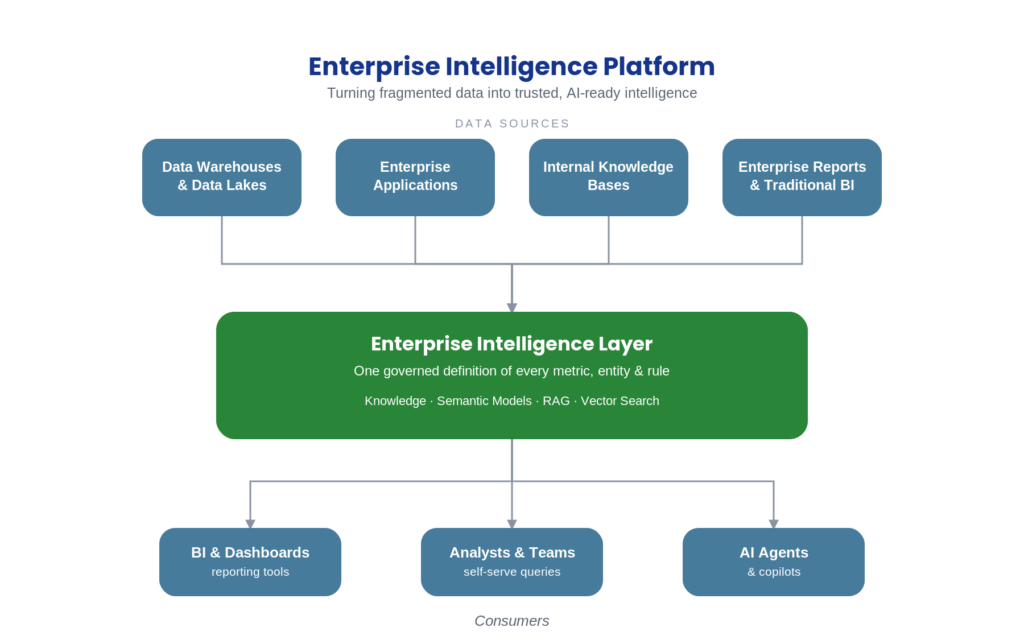
Data sources. The platform starts by pulling together the full range of enterprise data: data warehouses and data lakes, enterprise applications, internal knowledge bases, and enterprise reports and traditional BI tools. These are the systems where enterprise data already lives today — the platform doesn’t require ripping them out, only unifying access to them.
The centralized semantic layer. This is the core of the platform, and the piece most organizations have historically lacked. It provides one governed definition of every metric, entity, and business rule in the enterprise, and it’s built to be governed, consistent, reusable, and machine-readable. That last property matters as much as the first three: a definition that only a human can interpret from a spreadsheet footnote is of no use to an AI agent. The semantic layer has to encode business logic in a form that both a dashboard and a language model can query and get the identical answer from.
Consumers. Everything downstream draws from that single layer instead of reaching around it. BI and dashboards continue to serve traditional reporting needs. Analysts and teams get self-serve query access without needing to reverse-engineer what a number means. And AI agents and copilots — the newest and fastest-growing category of consumer — query the same governed definitions, which is what allows their answers to be trusted rather than double-checked.
The architectural insight here is subtle but important: the semantic layer isn’t a reporting tool bolted onto the data stack. It’s positioned as shared infrastructure that every consumer, present and future, is built to depend on.
What This Means for Data Leaders
For CIOs, CDOs, and heads of data, the Enterprise Intelligence Platform represents a shift in what “data infrastructure” needs to accomplish. It’s no longer sufficient to make data available — it has to be made consistent, governed, and legible to systems that will act on it autonomously. Organizations that build this foundation now are positioning themselves to deploy AI agents with confidence rather than caution. Organizations that don’t are likely to spend the next several years discovering, one inconsistent answer at a time, why the foundation mattered.
About CloudEQS
CloudEQS is a Premier Services Partner specializing in data strategy, data modeling, data engineering, data architecture, and AI enablement. Operating across the US, India, and remote teams, CloudEQS helps enterprises turn fragmented data into governed, AI-ready foundations like the Enterprise Intelligence Platform described above.
Interested in enabling your Enterprise Intelligence Platform? Connect with our team to talk through your use case.

Comments are closed