


Overview
Every data team knows the morning routine: a dbt model failed overnight, a Matillion job stalled, or a Snowflake query hit a permission error, and the dashboards your executives open at 8 a.m. are stale. Someone must dig through logs across three tools to work out what broke and why.
A self-healing data pipeline changes that routine. Instead of sending an alert and waiting for a person, an AI agent investigates the failure, finds the root cause, returns the fix in plain language, and remembers the incident so the next one is resolved faster.
This post explains how CloudEQS built a self-healing pipeline for one of our enterprise clients. Using agentic AI on AWS Bedrock AgentCore, and what it means for data leaders running Snowflake, Matillion and dbt.
What is a self-healing data pipeline?
A self-healing data pipeline is a data pipeline paired with an autonomous AI agent that detects failures, diagnoses their root cause and returns the resolution, with little or no manual investigation. Unlike traditional monitoring, which tells you that something failed, a self-healing pipeline tells you why it failed and how to fix it.
The difference is the agent. Monitoring tools stop at the alert. An agent reasons about the error, gathers evidence from the systems involved, and learns from each resolution.
How the self-healing pipeline works
The solution follows a simple four-stage loop: Detect, Diagnose, Resolve, Learn.
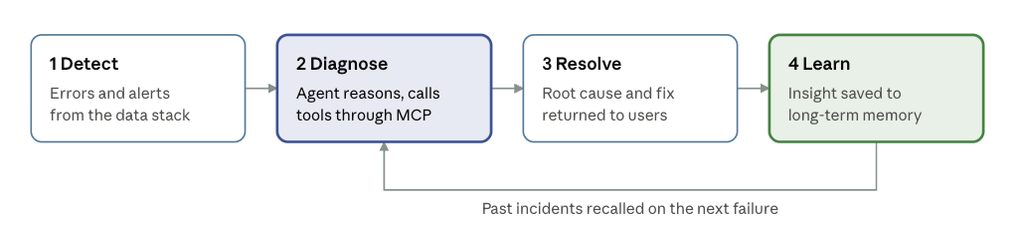
1. Detect: one error stream from the whole data stack
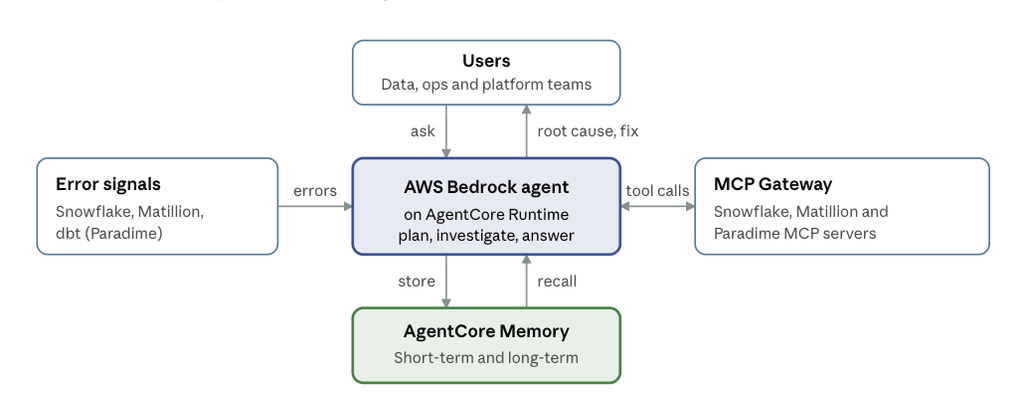
Error logs, alerts and events from Snowflake (query errors, job failures, permission and warehouse issues), Matillion (job, component, connection and transformation errors) and dbt via Paradime (compilation errors, model and test failures, run issues) flow into a single stream that starts an investigation.
2. Diagnose: an AI agent that reasons and investigates
The core of the solution is an AWS Bedrock agent running on AgentCore. It works through a reasoning loop: it plans the investigation, recalls similar past incidents from memory, queries each platform live, and then writes its conclusion.
The agent reaches each platform through the Model Context Protocol (MCP). A single MCP Gateway routes tool calls to dedicated MCP servers:
- Snowflake MCP server: schemas, queries and logs
- Matillion MCP server: jobs and components
- Paradime MCP server: dbt models, runs and tests
Because every tool sits behind one gateway, adding a new platform means adding one MCP server. The agent itself does not change.
3. Resolve: root cause and fix in plain language
Data engineers, operations and platform teams can ask the agent a question, such as “Why did the dbt job fail?”, through chat or a web app. The agent answers with the root cause, the resolution and recommendations to prevent a repeat.
4. Learn: long-term memory that compounds
This is what makes the pipeline self-healing over time. Bedrock AgentCore Memory stores each investigation and automatically extracts reusable insights into long-term memory:
- Semantic memory: error patterns, root causes and solutions
- Episodic memory: past incidents
- Summary memory: investigation history
Memory is scoped by namespace, per tool and per environment, so production insights stay separate from development. A memory record can show that a given error has been seen seven times and always traced to the same upstream cause, so the agent reaches the answer immediately and your team can fix the cause for good.
Built for enterprise: the agentic architecture
The self-healing pipeline lowers the cost of running your data platform. Failures are fixed faster, engineering time and compute aren’t wasted on firefighting, and you can scale data operations without adding headcount.
For CIOs and Chief Data Officers, the architecture matters as much as the outcome:
- Fully managed on AWS: Bedrock AgentCore Runtime handles session management, tool calling, scaling, and observability and tracing.
- Governed tool access: guardrails and security controls apply to every tool call made through the MCP Gateway.
- Auditable by design: every step of every investigation is traced, which supports post-mortems and compliance reviews.
- Modular and extensible: new data platforms plug in as MCP servers without rebuilding the agent.
Frequently asked questions
Summary
CloudEQS is a Snowflake Premier partner and a Matillion Gold Service Partner that helps data teams build Enterprise Intelligence Platforms. To see how a self-healing pipeline would work on your Snowflake, Matillion and dbt stack, schedule a demo today.

Comments are closed